
Ukir, Tatah, and Patung: Untangling the Roots of Jepara's Carving Craft (And Why It's Not the Same as Sculpture)
Article
Fadli
7/10/20266 min read
Ukir, Tatah, and Patung: Untangling the Roots of Jepara's Carving Craft (And Why It's Not the Same as Sculpture)
If you've spent any time around Jepara, you've probably noticed something a little confusing. People throw around words like ukir, tatah, pahat, and patung almost interchangeably, as if they're all just different names for the same skill. They're not. And once you understand why, you start to see Jepara's carving tradition in a completely different light, not as one big blanket craft, but as several distinct disciplines that happen to share the same hands, the same tools, and often the same workshop.
So let's slow down and actually unpack this. Where did Jepara's carving tradition come from, what's the real difference between ukir and tatah, and why isn't a carver the same thing as a sculptor?
It All Starts With a Slightly Wild Legend
Every good craft tradition needs an origin story, and Jepara's is a strange one. Long before the region became known for teak furniture, there's a folk tale about a painter and carver named Prabangkara who worked during the Majapahit era. As the story goes, King Brawijaya asked him to paint the queen, but forbade him from actually looking at her directly. Prabangkara painted from imagination alone, and somehow got it eerily right, down to a birthmark in the exact right spot. The king, convinced this was proof Prabangkara had secretly seen his wife, flew into a rage. His punishment was brutal and bizarre: tied to a kite and sent flying. The kite eventually came down in an area now known as Mulyoharjo, right in Jepara.
According to the legend, Prabangkara stayed there and taught the local community how to carve. That skill, the story goes, never really left.
Now, whether this actually happened is beside the point. What matters is what the story tells us about how Jepara sees itself: carving here isn't treated as a trade someone picked up for income. It's treated as something inherited, almost sacred, passed down like a family name.
Ratu Kalinyamat and the Real Historical Turning Point
Legends aside, historians point to something more concrete happening around 1549, during the rule of Ratu Kalinyamat. This was when carving in Jepara really started to flourish, partly thanks to a figure named Sungging Badarduwung, a master carver believed to have Champa origins. He's credited with the stone reliefs at Masjid Mantingan, and many historians now consider those very carvings the direct ancestor of the flowing, vine-like relung motifs that Jepara woodcarving is famous for today.
In other words, before Jepara had a single furniture workshop, it already had these stone panels sitting quietly on a mosque wall, being studied, copied, and reinterpreted by local artisans for generations.
Then Kartini Changed the Whole Trajectory
Here's where the story shifts from artistic heritage to actual economic history, and this part matters a lot. R.A. Kartini, Jepara's most famous daughter, didn't just admire the region's carving talent. She saw carvers in Belakang Gunung (now Mulyoharjo) who were undeniably skilled but still living in poverty, and that bothered her deeply.
So she did something practical. She gathered local craftsmen and had them produce small, sellable items, sewing boxes, side tables, picture frames, jewelry boxes, and started selling these pieces in Semarang and Batavia. Orders started coming in. Kartini then went further, sending samples and gifts to her contacts in the Netherlands, effectively becoming Jepara's first informal export agent.
There's a fascinating detail that recent research has uncovered, particularly from the 2026 TATAH exhibition team, who found archival evidence that Jepara's carvers were later recruited to build an entire ornamental room called the Indische Zaal in Batavia. That room reportedly ended up inside the Dutch royal palace. So Jepara's international reputation as a carving powerhouse isn't some modern marketing invention. It goes back centuries, quietly proven long before "export furniture" became an industry term.
Ukir vs Tatah: Two Words, One Craft, Slightly Different Angles
This is the part people usually get wrong, mostly because in everyday conversation, "ukir" and "tatah" get used as if they mean the exact same thing. They're closely related, but not identical.
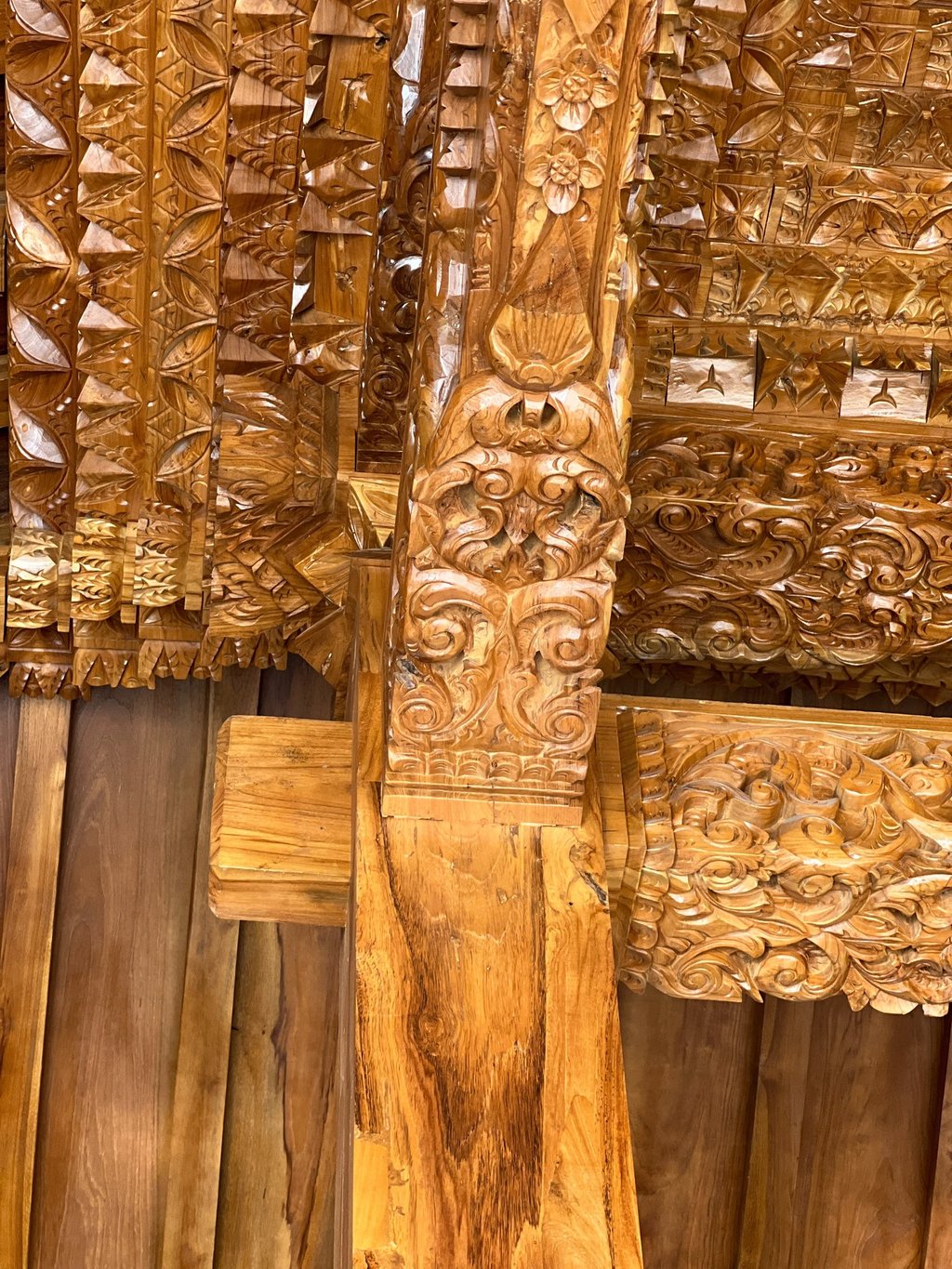
Ukir refers to the overall art form and its result, the carved motif itself. It's typically two-dimensional in the sense that it lives on a flat surface, even though it has real depth and texture, like a relief pattern carved into a door panel or cabinet face.
Tatah refers more specifically to the technique and tool, the act of chiseling and cutting into wood with a small chisel (also called tatah) and a wooden mallet, gradually removing material to reveal the raised and recessed shapes of a design.
So when someone talks about Jepara's "seni tatah dan ukir," they're really describing one continuous process: designing a motif, then physically chiseling it into existence. It's not two separate crafts stacked together. It's one craft described from two different angles, the technique and the outcome.
This distinction was actually front and center in a major national exhibition called TATAH, held at the National Museum of Indonesia from April through July 2026. Organizers deliberately used the word "tatah" instead of the more commercial-sounding "ukir Jepara" branding, specifically to shift attention back toward the technical mastery behind the craft rather than just the finished product people buy.
So What Actually Separates a Carver From a Sculptor?
This is the question that trips up a lot of people, because visually, carvers and sculptors use overlapping tools, chisels, mallets, sometimes the exact same wood. But the disciplines diverge in a few clear ways.
Dimension of the final piece. Carving generally produces relief work, patterns that exist on a flat plane and are meant to be viewed from one primary angle, like a panel, a door, or a piece of furniture. Sculpture is fully three-dimensional. It stands alone and can be viewed and appreciated from every angle.
Purpose. Carving usually decorates something else. It enhances furniture, doorways, architectural elements, ceremonial gates like gebyok. Sculpture, on the other hand, typically exists as a complete artistic statement on its own, whether for aesthetic, religious, or commemorative purposes.
The underlying process. In carving, the artist works on a relatively flat surface, creating the illusion of depth through carefully controlled convex and concave cuts. In sculpture, particularly with chisel-based techniques, the artist is removing material from a solid block to free a fully-formed three-dimensional shape, closer to the way classical Western sculptors like Michelangelo approached marble.
What you call the person. Someone who carves is a pengukir. Someone who sculpts is a pematung, a term borrowed from the English word "sculptor."
Here's what makes Jepara genuinely interesting though: these two disciplines don't stay neatly separated in practice. Mulyoharjo, the same village tied to the Prabangkara legend, is known today as a center for both relief carving and wood sculpture. Its most famous product, the Macan Kurung (literally "caged tiger") sculpture, actually fuses the two disciplines together. It combines the intricate, lattice-like piercing technique typical of ukir with the fully three-dimensional form of a sculpted tiger. On paper, carving and sculpture are two different things. In the hands of Jepara's craftsmen, that line gets blurred on purpose, and that's exactly what makes their work so hard to replicate elsewhere.
A Tradition That Refuses to Sit Still
What keeps this story relevant isn't just its age, it's how consistently it's been passed forward without losing its core. As Indonesia's Minister of Culture Fadli Zon put it when opening the TATAH 2026 exhibition, Jepara's carving tradition has roots running more than five hundred years deep, starting with the reliefs at Masjid Mantingan.
Behind every carved cabinet or relief panel that looks simple on the surface, there's actually a long chain connecting today's craftsmen to Prabangkara's legend, Ratu Kalinyamat's artistic ambitions, and Kartini's very deliberate effort to put Jepara on the world's map. That's not a small inheritance to carry, and honestly, it shows in the work.
Further Reading & Sources
Books & Academic Research
Karmadi, A.D. & Kartadarmadja, M.S. (1985). Sejarah Perkembangan Seni Ukir di Jepara. Jakarta: Departemen Pendidikan dan Kebudayaan.
Sumartono, A. (1997). Desain Ukir Jepara: Kajian Tentang Kreativitas Seni pada Masyarakat Perajin Ukir di Desa Sukodono, Jepara, Jawa Tengah. Jakarta: Universitas Indonesia.
Indrahti, S. (2022). Dinamika Dimensi Budaya Kerajinan Ukir Jepara: dari Seni Hias Dinding Masjid Mantingan Menuju Pasar Internasional. Anuva: Jurnal Kajian Budaya, Perpustakaan, dan Informasi, 6(2), 179–188.
Gustami, SP. (2000). Seni Kerajinan Mebel Ukir Jepara. Yogyakarta: Kanisius.
Web Sources
Kartini FM Diskominfo Jepara — Pameran "Tatah" Angkat Sejarah Panjang Ukir Jepara
Infojateng.id — Resmi Dibuka, TATAH 2026 Angkat Seni Ukir Jepara ke Level Mahakarya
TATAH.id — Menerjemahkan Naskah Belanda untuk Pelestarian Seni Ukir Jepara
Telkom University — Seni Patung: Pengertian, Bahan, Teknik, dan Contoh Karya di Indonesia